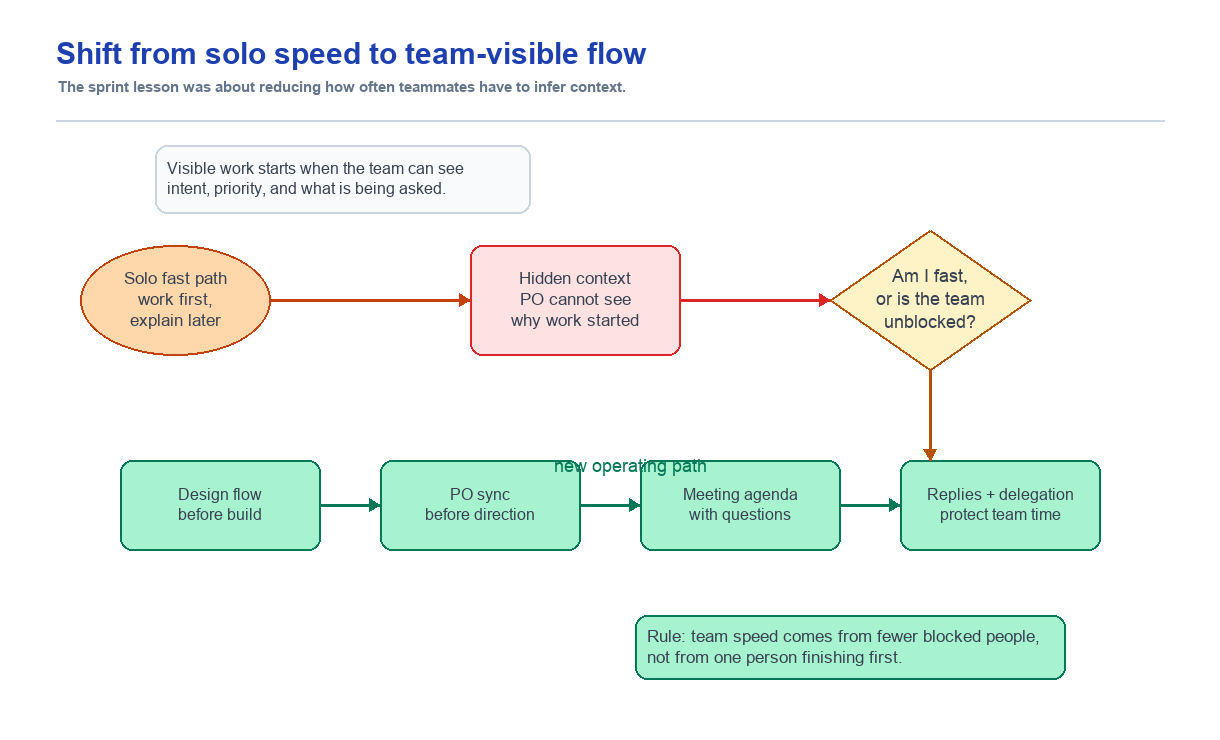
One thing I learned while building Place2Page is that development speed is not defined only by individual implementation speed. At first, I thought moving quickly, organizing things myself, and building ahead would help the team. But when I collected feedback, the bottleneck was not the amount of implementation. It was how visible the work was, when design and product judgment were aligned, and whether teammates had to wait for communication.
Summary
- Problem: The way I handled things quickly did not always translate into team-level speed.
- Judgment: More than ticket count or implementation speed, the team needed to see when work started and what criteria were being used.
- Feedback: There were improvement points around design flow, PO sync, meeting preparation, reply speed, and preparation for support programs.
- Lesson: A good team lead is closer to someone who reduces blockers for teammates than someone who carries a lot alone.
Context
While working on Place2Page, I had many moments where I thought less about development itself and more about how to work as a team. In a small team, someone often has to move first for work to start moving. I also handled many things that way.
But moving quickly alone is different from helping the team move well together. If the work I handled first is not visible to teammates, it can become uncertainty rather than speed. Work I carried first out of responsibility can later come back as the cost of realigning direction.
This post is a midpoint review of my working style, based on feedback I received over about a month.
Align Visual Outputs Before Development
In the beginning, I sometimes built the frontend first and got design feedback after there was something to look at.
It felt efficient to find assets quickly from tools like 21st.dev or lottiefiles.com, customize them, and show the result. But a customer-facing output like a landing page is not done just because the feature works. The flow, visual taste, copy, and demo impression all need to line up.
For visible outputs, it is better to align the design flow before development than to ask for review after implementation. After development, the flow should feel more like QA.
Building fast still matters, but the cost of changing direction later is not small. From the next sprint, I want to work from completed planning and design, then use QA after development as the default flow.
Make Work Visible to the PO
I also received feedback that the PO did not have enough visibility into what I was doing.
When I see something that needs to be done, I tend to handle it first and share after it is somewhat organized. That has the advantage of speed. But from the team's point of view, it can be hard to see what I am working on and which judgment made me start it.
This matters even more when product direction or priority is involved. If I share only after I have already made progress, the PO cannot see the intermediate reasoning. Then the moment to align priority or direction comes too late.
So I want to move less like "act first, report later" and share briefly before starting.
I will check this part first.
I will organize this ticket today around the P0 standard.
For this one, I will align the direction with the PO before development.
For visible outputs, I will align the design flow first. For product direction or priority decisions, I will sync with the PO first.
In a small team, long reporting is often less important than making the start of work visible to each other. If teammates can see what I am doing, they can decide sooner whether to wait, help, or change direction.
Do Not Overinterpret Discord Feedback Alone
When feedback comes through text, I sometimes read more tone into it than the sender intended. Especially when I am busy or already deep in a task, short messages can feel more defensive than they are.
But Discord text naturally loses a lot of context. The other person may not be evaluating me. They may simply be asking for the alignment needed at that moment.
So when something is ambiguous, I should ask directly instead of interpreting it alone. I am practicing moving quickly from "What does this mean?" to "What standard do I need to check now?"
Share Meeting Requests With Agenda Items
For U300, I once asked whether there was anything to discuss before a meeting. In my head, there were agenda items: how to run U300, interview results, and software support needed for 300 outreach attempts.
But if I do not say those first, the other person cannot tell what is different from the existing preparation. I thought I was asking lightly, but for the receiver it could become, "So what should I prepare?"
Going forward, I will share meeting preparation in this structure:
- Agenda items
- Questions I want to check
- Decisions needed
- Areas where I can support
Meeting preparation is also a small product document. The important thing is to make sure the other person does not have to guess the context in my head.
Do Not Miss Communication While Focused
When I get deep into a task, I tend to block out almost everything that feels less important. This can help when developing. But it is not always a good habit when working as a team.
If my reply is late, the other person has to wait, ask again, or decide alone during that time. If I reply quickly, even briefly, I can save their time.
Recently I have been realizing that checking messages and replying as soon as possible is part of basic collaboration etiquette. Trust is not built only by doing big things. Reducing small blocked moments also affects trust and team speed.
I have not fixed this well yet, but I am trying to stay aware of it.
Do Not Carry Support Program Preparation Alone
For work like U300 or startup support applications, presentations, slides, copy, business planning, and team strategy are all connected. If I try to carry all of that alone, I hit limits quickly.
At first, I sometimes thought I could not contribute much unless I was excellent at writing or business plan documents. But active brainstorming with the team produced many more useful ideas.
The process itself also seems to give the other person more stability. Looking at a blank document alone feels much more uncertain than having someone next to you thinking through it together.
As a team lead, I should not be someone who does everything alone. I should be someone who helps teammates play their roles, think together, and divide the work. I want to become the kind of lead the team can trust and lean on in that way.
How I Will Judge This Next Time
Going forward, I will ask "Does the team need to wait or guess because of this?" before asking "Can I finish this quickly?" When individual speed increases team uncertainty, sharing comes first.
My execution standard is:
- Reduce tickets around goals instead of creating many tickets.
- Align the design flow before developing visible outputs.
- Sync with the PO before work that affects product direction or priority.
- Instead of acting first and reporting later, say "I am going to work on this" before starting.
- Do not interpret Discord feedback alone. Confirm the needed intent.
- Share meeting preparation as separate agenda items and questions.
- Even while focused, try not to miss replies that save teammates' time.
- Delegate more actively for complex work like U300, applications, presentations, and marketing execution.
Looking Back
The strongest lesson from this midpoint review is that developer speed is not only individual working speed.
Building quickly alone is sometimes necessary. But if the team is not moving with the same criteria, we end up reorganizing, re-explaining, and reworking. In an early product, tickets, design flow, PO sync, meeting agenda, reply speed, and R&R affect product speed as much as code does.
These days, I am trying to ask more often: "Is the team less blocked and moving together?" instead of only "Can I handle this quickly?"